Me and my team are now working on a website http://clevermuslim.com
Join us! Coming really soon...
Saturday, October 12, 2019


Tuesday, April 1, 2014
Tariq Ramadan on "Islam is a European Religion"
Tariq Ramadan, Swiss author talks a lot about European Muslim identity. One of his books is titled To be a European Muslim. In this video he is talking about Islam as a European religion.
Monday, March 31, 2014
Bulgaria:Trial Against 13 Imams
Bulgaria's Court Finds 13 Imams Guilty
http://www.novinite.com/articles/159077/Bulgaria%27s+Court+Finds+13+Imams+Guilty
Bulgaria's Chief Mufti's Office: Trial Against Imams Is a Disgrace
http://www.novinite.com/articles/159306/Bulgaria%27s+Chief+Mufti%27s+Office%3A+Trial+Against+Imams+Is+A+Disgrace
http://www.novinite.com/articles/159077/Bulgaria%27s+Court+Finds+13+Imams+Guilty
Bulgaria's Chief Mufti's Office: Trial Against Imams Is a Disgrace
http://www.novinite.com/articles/159306/Bulgaria%27s+Chief+Mufti%27s+Office%3A+Trial+Against+Imams+Is+A+Disgrace
's Office: Trial Against Imams Is A Disgrace
's Office: Trial Against Imams Is A Disgrace
Saturday, March 29, 2014
The Guardian: War is over – now Serbs and Bosniaks fight to win control of a brutal history
Serb nationalists trying to suppress reminders of atrocities committed against country's Muslims 20 years ago
http://www.theguardian.com/world/2014/mar/23/war-serbs-bosniaks-history-visegrad
Wednesday, July 29, 2009
European Imams and Rabbis visit USA for Dialogue
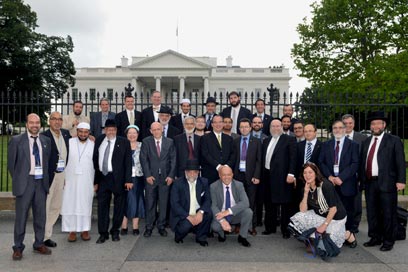
After a tour of the U.S. Capitol, the group will meet with Democratic Reps. Keith Ellison of Minnesota and Andre Carson of Indiana, both Muslims, along with two leaders of the unofficial Congressional Jewish Caucus, Democratic Reps. Jerrold Nadler of New York and Robert Wexler of Florida.
The delegation then attends a dinner hosted by the ISNA at the All Dulles Area Muslim Society, where they will hear from Imam Yahya Hindi of Georgetown University and Rabbi Gerry Serotta, North American chairman of Rabbis for Human Rights.
On Thursday, the group will visit the White House to meet with Joshua Dubois, executive director of the Office of Faith-based and Neighborhood Partnerships. After lunch at the Saudi Embassy, the group flies home.
"The great challenge of the 21st century in inter-religious dialogue is to find the path to narrow the gap between Muslims and Jews worldwide," said Mr. Schneier of FFEU. "The foundation, which I co-founded 20 years ago, is known for our work in black-Jewish relations. We own this issue nationwide."
The delegation then attends a dinner hosted by the ISNA at the All Dulles Area Muslim Society, where they will hear from Imam Yahya Hindi of Georgetown University and Rabbi Gerry Serotta, North American chairman of Rabbis for Human Rights.
On Thursday, the group will visit the White House to meet with Joshua Dubois, executive director of the Office of Faith-based and Neighborhood Partnerships. After lunch at the Saudi Embassy, the group flies home.
"The great challenge of the 21st century in inter-religious dialogue is to find the path to narrow the gap between Muslims and Jews worldwide," said Mr. Schneier of FFEU. "The foundation, which I co-founded 20 years ago, is known for our work in black-Jewish relations. We own this issue nationwide."
Note: ISNA is Islamic Society of North America
(Full story in The Washinton Post)
Also visit ynetnews
Tuesday, July 28, 2009
Former German MTV host promotes Islam with new autobiography
 Former MTV host Kristiane Backer got to know Islam through an ex-boyfriend, and later converted. Now, over a decade later, she's promoting understanding for the religion in her newly published autobiography.
In 1991, Kristiane Backer had the life thousands of young people dream of: She had been selected among thousands of contenders as the first German VJ for MTV Europe.
Still, she was empty inside. "I am feeling so low," she wrote in her diary.
Then, in August 1992, she fell in love with Pakistan’s most famous cricket player Imran Khan. The relationship ended two years later, but Backer went on to convert to Islam in 1995.
Her story was recently published in a book entitled "From MTV to Mecca, how Islam changed my life."
Disappointment with the entertainment world
In the biography, Backer talks openly about the superficiality of the television and music business - which almost broke her, she says - and about her two failed marriages.
As a convert to Islam, she has been living between two worlds, not feeling fully accepted by either. Having grown up as a Protestant in Hamburg, the 43-year-old Backer now prays five times a day to Allah and follows the Muslim law of abstaining from alcohol. She donates money to the poor and observes the Ramadan fast.
"I would be happy if my book inspired people to discover their spiritual side and to open themselves up," said the former VJ. "On the other hand, I want to help clarify some prejudices against Islam. I want to build bridges and help support the dialogue between different religions and cultures."
Backer met cricketer Imran Khan in London in 1992. He introduced her to the teachings of the Koran. During their nearly two-year relationship, Backer visited Pakistan many times with Khan, who is considered a national legend for leading Pakistan to their first Cricket World Cup win in 1992.
For the German television host, a new world opened up. Even after Khan decided to end their relationship, Backer became a Muslim in 1995 and quit her job at MTV.
Fascination with humanity
"First, your relationship with God in Islam is very close because you pray so many times a day. If you pray five times a day, you are connecting yourself with God every time you pray," said Backer, adding that she couldn't understand some of the Christian doctrines she had grown up with.
"I was also fascinated by the humanity of the people I met, which can be seen all over the Orient."
After her conversion, Backer started wearing long skirts and long sleeves. Her parents, relatives and friends were worried at first, but ultimately accepted her decision.
The German media, however, have not been so kind. Critics have called Backer's book naive, saying she ignores negative sides of Muslim societies. But she argues that a lot of what is happening worldwide in the name of Islam is absolutely "un-islamic."
Backer believes that much of the current Islamophobia in Europe is tied to historical conflicts.
"At the time of Goethe, Oriental literature inspired the Romantic Movement," she said. "It seems that at that time, there was apparently a greater openness and maybe a greater understanding for other religions and cultures."
Backer said she has become more mature and composed over time. She lives as a on her own in London, but has still not lost hope of finding her Mr. Right. Inshallah - if it is God’s will - she said.
Author: Priya Esselborn
Editor: Grahame Lucas/Kate Bowen
BNP's Griffin: Islam is a cancer???
By Cathy Newman
As the BNP struggles for right-wing support in the European Parliament, leader Nick Griffin tells Cathy Newman he believes there is "no place in Europe for Islam". The BNP leader Nick Griffin has described Islam as a “cancer” that should be removed from Europe by "chemotherapy".
In an interview with Channel 4 News, Mr Griffin, who has just been elected to the European Parliament, said there was "no place in Europe for Islam".
He added: "Western values, freedom of speech, democracy and rights for women are incompatible with Islam, which is a cancer eating away at our freedoms and our democracy and rights for our women and something needs to be done about it".
The BNP leader said he agreed with a candidate for the Flemish far right party, Vlaams Belang, who had declared: "We urgently need global chemotherapy against Islam to save civilisation."
The remarks will fuel controversy over the BNP’s success at the European elections last month. The party’s two winning candidates - Nick Griffin and Andrew Brons - take up their seats in the European Parliament next week.
Mr Griffin has been holding talks with other far right parties in Europe such as Vlaams Belang and Jobbik, from Hungary.
The BNP had hoped to team up formally with a range of European rightwingers, giving them access to up to €1m of public money to spend on staff and offices. However, those talks have ended in failure.
The BNP will still work together informally with Jobbik, with both parties saying they share common ground on issues such as law and order.
Jobbik has formed its own militia, the Hungarian Guard, which wears Nazi-style uniform and marches across the country to tackle what it calls “gypsy crime” by Roma travellers.
Mr Griffin told Channel 4 News that he believed Britain had “got a problem with Romanian gypsy crime”. Jobbik’s use of the term has led to accusations that it is seeking to criminalise an entire ethnic group.
The BNP leader said: “There are two sorts of gypsies in Britain. There are the old fully-established anglicised Romanies who have been here for generations and who when they go to an area, when they leave it, it is spotlessly clean and you can not see they have been there. We have got no issue with that.
"And on the other hand there are the travellers - mainly from Ireland - and the Roma gypsy beggars and pickpockets in London. And while the liberal elite may say it is politically incorrect to say so, I would say that they have a very high level of criminality."
One of Jobbik’s MEPs, Krisztina Morvai, has been accused of anti-Semitism after text she wrote on an online forum.
Questioned by Channel 4 News about the remarks, she did not deny writing them, but said she did not want to make any comment. She then terminated the interview.
Although Jobbik still sees the BNP as an ally, Vlaams Belang distanced itself both from Mr Griffin and the call by one of its candidates for "global chemotherapy" against Islam. One of its MEPs said he did not agree with comparing "people to diseases".
(Channel4)
(Channel4 video)
As the BNP struggles for right-wing support in the European Parliament, leader Nick Griffin tells Cathy Newman he believes there is "no place in Europe for Islam". The BNP leader Nick Griffin has described Islam as a “cancer” that should be removed from Europe by "chemotherapy".
In an interview with Channel 4 News, Mr Griffin, who has just been elected to the European Parliament, said there was "no place in Europe for Islam".
He added: "Western values, freedom of speech, democracy and rights for women are incompatible with Islam, which is a cancer eating away at our freedoms and our democracy and rights for our women and something needs to be done about it".
The BNP leader said he agreed with a candidate for the Flemish far right party, Vlaams Belang, who had declared: "We urgently need global chemotherapy against Islam to save civilisation."
The remarks will fuel controversy over the BNP’s success at the European elections last month. The party’s two winning candidates - Nick Griffin and Andrew Brons - take up their seats in the European Parliament next week.
Mr Griffin has been holding talks with other far right parties in Europe such as Vlaams Belang and Jobbik, from Hungary.
The BNP had hoped to team up formally with a range of European rightwingers, giving them access to up to €1m of public money to spend on staff and offices. However, those talks have ended in failure.
The BNP will still work together informally with Jobbik, with both parties saying they share common ground on issues such as law and order.
Jobbik has formed its own militia, the Hungarian Guard, which wears Nazi-style uniform and marches across the country to tackle what it calls “gypsy crime” by Roma travellers.
Mr Griffin told Channel 4 News that he believed Britain had “got a problem with Romanian gypsy crime”. Jobbik’s use of the term has led to accusations that it is seeking to criminalise an entire ethnic group.
The BNP leader said: “There are two sorts of gypsies in Britain. There are the old fully-established anglicised Romanies who have been here for generations and who when they go to an area, when they leave it, it is spotlessly clean and you can not see they have been there. We have got no issue with that.
"And on the other hand there are the travellers - mainly from Ireland - and the Roma gypsy beggars and pickpockets in London. And while the liberal elite may say it is politically incorrect to say so, I would say that they have a very high level of criminality."
One of Jobbik’s MEPs, Krisztina Morvai, has been accused of anti-Semitism after text she wrote on an online forum.
Questioned by Channel 4 News about the remarks, she did not deny writing them, but said she did not want to make any comment. She then terminated the interview.
Although Jobbik still sees the BNP as an ally, Vlaams Belang distanced itself both from Mr Griffin and the call by one of its candidates for "global chemotherapy" against Islam. One of its MEPs said he did not agree with comparing "people to diseases".
(Channel4)
(Channel4 video)
Subscribe to:
Posts (Atom)