Me and my team are now working on a website http://clevermuslim.com
Join us! Coming really soon...
Saturday, October 12, 2019


Tuesday, April 1, 2014
Tariq Ramadan on "Islam is a European Religion"
Tariq Ramadan, Swiss author talks a lot about European Muslim identity. One of his books is titled To be a European Muslim. In this video he is talking about Islam as a European religion.
Monday, March 31, 2014
Bulgaria:Trial Against 13 Imams
Bulgaria's Court Finds 13 Imams Guilty
http://www.novinite.com/articles/159077/Bulgaria%27s+Court+Finds+13+Imams+Guilty
Bulgaria's Chief Mufti's Office: Trial Against Imams Is a Disgrace
http://www.novinite.com/articles/159306/Bulgaria%27s+Chief+Mufti%27s+Office%3A+Trial+Against+Imams+Is+A+Disgrace
http://www.novinite.com/articles/159077/Bulgaria%27s+Court+Finds+13+Imams+Guilty
Bulgaria's Chief Mufti's Office: Trial Against Imams Is a Disgrace
http://www.novinite.com/articles/159306/Bulgaria%27s+Chief+Mufti%27s+Office%3A+Trial+Against+Imams+Is+A+Disgrace
's Office: Trial Against Imams Is A Disgrace
's Office: Trial Against Imams Is A Disgrace
Saturday, March 29, 2014
The Guardian: War is over – now Serbs and Bosniaks fight to win control of a brutal history
Serb nationalists trying to suppress reminders of atrocities committed against country's Muslims 20 years ago
http://www.theguardian.com/world/2014/mar/23/war-serbs-bosniaks-history-visegrad
Wednesday, July 29, 2009
European Imams and Rabbis visit USA for Dialogue
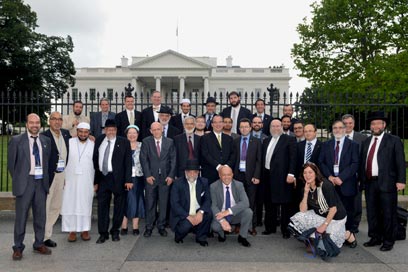
After a tour of the U.S. Capitol, the group will meet with Democratic Reps. Keith Ellison of Minnesota and Andre Carson of Indiana, both Muslims, along with two leaders of the unofficial Congressional Jewish Caucus, Democratic Reps. Jerrold Nadler of New York and Robert Wexler of Florida.
The delegation then attends a dinner hosted by the ISNA at the All Dulles Area Muslim Society, where they will hear from Imam Yahya Hindi of Georgetown University and Rabbi Gerry Serotta, North American chairman of Rabbis for Human Rights.
On Thursday, the group will visit the White House to meet with Joshua Dubois, executive director of the Office of Faith-based and Neighborhood Partnerships. After lunch at the Saudi Embassy, the group flies home.
"The great challenge of the 21st century in inter-religious dialogue is to find the path to narrow the gap between Muslims and Jews worldwide," said Mr. Schneier of FFEU. "The foundation, which I co-founded 20 years ago, is known for our work in black-Jewish relations. We own this issue nationwide."
Note: ISNA is Islamic Society of North America
(Full story in The Washinton Post)
Also visit ynetnews
Tuesday, July 28, 2009
Former German MTV host promotes Islam with new autobiography
 Former MTV host Kristiane Backer got to know Islam through an ex-boyfriend, and later converted. Now, over a decade later, she's promoting understanding for the religion in her newly published autobiography.
In 1991, Kristiane Backer had the life thousands of young people dream of: She had been selected among thousands of contenders as the first German VJ for MTV Europe.
Still, she was empty inside. "I am feeling so low," she wrote in her diary.
Then, in August 1992, she fell in love with Pakistan’s most famous cricket player Imran Khan. The relationship ended two years later, but Backer went on to convert to Islam in 1995.
Her story was recently published in a book entitled "From MTV to Mecca, how Islam changed my life."
Disappointment with the entertainment world
In the biography, Backer talks openly about the superficiality of the television and music business - which almost broke her, she says - and about her two failed marriages.
As a convert to Islam, she has been living between two worlds, not feeling fully accepted by either. Having grown up as a Protestant in Hamburg, the 43-year-old Backer now prays five times a day to Allah and follows the Muslim law of abstaining from alcohol. She donates money to the poor and observes the Ramadan fast.
"I would be happy if my book inspired people to discover their spiritual side and to open themselves up," said the former VJ. "On the other hand, I want to help clarify some prejudices against Islam. I want to build bridges and help support the dialogue between different religions and cultures."
Backer met cricketer Imran Khan in London in 1992. He introduced her to the teachings of the Koran. During their nearly two-year relationship, Backer visited Pakistan many times with Khan, who is considered a national legend for leading Pakistan to their first Cricket World Cup win in 1992.
For the German television host, a new world opened up. Even after Khan decided to end their relationship, Backer became a Muslim in 1995 and quit her job at MTV.
Fascination with humanity
"First, your relationship with God in Islam is very close because you pray so many times a day. If you pray five times a day, you are connecting yourself with God every time you pray," said Backer, adding that she couldn't understand some of the Christian doctrines she had grown up with.
"I was also fascinated by the humanity of the people I met, which can be seen all over the Orient."
After her conversion, Backer started wearing long skirts and long sleeves. Her parents, relatives and friends were worried at first, but ultimately accepted her decision.
The German media, however, have not been so kind. Critics have called Backer's book naive, saying she ignores negative sides of Muslim societies. But she argues that a lot of what is happening worldwide in the name of Islam is absolutely "un-islamic."
Backer believes that much of the current Islamophobia in Europe is tied to historical conflicts.
"At the time of Goethe, Oriental literature inspired the Romantic Movement," she said. "It seems that at that time, there was apparently a greater openness and maybe a greater understanding for other religions and cultures."
Backer said she has become more mature and composed over time. She lives as a on her own in London, but has still not lost hope of finding her Mr. Right. Inshallah - if it is God’s will - she said.
Author: Priya Esselborn
Editor: Grahame Lucas/Kate Bowen
BNP's Griffin: Islam is a cancer???
By Cathy Newman
As the BNP struggles for right-wing support in the European Parliament, leader Nick Griffin tells Cathy Newman he believes there is "no place in Europe for Islam". The BNP leader Nick Griffin has described Islam as a “cancer” that should be removed from Europe by "chemotherapy".
In an interview with Channel 4 News, Mr Griffin, who has just been elected to the European Parliament, said there was "no place in Europe for Islam".
He added: "Western values, freedom of speech, democracy and rights for women are incompatible with Islam, which is a cancer eating away at our freedoms and our democracy and rights for our women and something needs to be done about it".
The BNP leader said he agreed with a candidate for the Flemish far right party, Vlaams Belang, who had declared: "We urgently need global chemotherapy against Islam to save civilisation."
The remarks will fuel controversy over the BNP’s success at the European elections last month. The party’s two winning candidates - Nick Griffin and Andrew Brons - take up their seats in the European Parliament next week.
Mr Griffin has been holding talks with other far right parties in Europe such as Vlaams Belang and Jobbik, from Hungary.
The BNP had hoped to team up formally with a range of European rightwingers, giving them access to up to €1m of public money to spend on staff and offices. However, those talks have ended in failure.
The BNP will still work together informally with Jobbik, with both parties saying they share common ground on issues such as law and order.
Jobbik has formed its own militia, the Hungarian Guard, which wears Nazi-style uniform and marches across the country to tackle what it calls “gypsy crime” by Roma travellers.
Mr Griffin told Channel 4 News that he believed Britain had “got a problem with Romanian gypsy crime”. Jobbik’s use of the term has led to accusations that it is seeking to criminalise an entire ethnic group.
The BNP leader said: “There are two sorts of gypsies in Britain. There are the old fully-established anglicised Romanies who have been here for generations and who when they go to an area, when they leave it, it is spotlessly clean and you can not see they have been there. We have got no issue with that.
"And on the other hand there are the travellers - mainly from Ireland - and the Roma gypsy beggars and pickpockets in London. And while the liberal elite may say it is politically incorrect to say so, I would say that they have a very high level of criminality."
One of Jobbik’s MEPs, Krisztina Morvai, has been accused of anti-Semitism after text she wrote on an online forum.
Questioned by Channel 4 News about the remarks, she did not deny writing them, but said she did not want to make any comment. She then terminated the interview.
Although Jobbik still sees the BNP as an ally, Vlaams Belang distanced itself both from Mr Griffin and the call by one of its candidates for "global chemotherapy" against Islam. One of its MEPs said he did not agree with comparing "people to diseases".
(Channel4)
(Channel4 video)
Christian Democrats against new mosque in Brno
Brno, July 27 (CTK) - South Moravian Christian Democrats (KDU-CSL) are against the construction of a second mosque in Brno, Stanislav Juranek, chairman of the regional party organisation, said Monday.
He said the Muslims who want to live in the Czech Republic should adapt themselves to the local traditions.
"It would be a great mistake to allow them (traditions) being pushed away by a foreign culture and religion," he told journalists.
Munib Hasan, from the Brno-based Islamic foundation, who recently announced the plan to build a new mosque, dismissed Juranek's opinion.
He said Brno Muslims have always rejected any radicalism and oppression.
KDU-CSL deputy chairman David Macek said the Christian Democrats recognise freedom of religious faith, but added he is embarrassed about some demands of Islamists.
He said, for instance, Vladimir Sanka writes in a manual on what is allowed and what is banned in Islam that Muslims need not obey anyone who does not preach Islam.
The manual also sets death penalty for unfaithful women and renegades from Islam, Macek said.
Hasan said the sentences are torn out of context. He added that it is necessary to look at the teaching of the churches as such, not at individuals' opinions.
"One thing is toleration and another thing is naivety. Such a group should not be accommodated in southern Moravia," Macek said.
He said the Czech Republic should not repeat the mistakes of western Europe where many Islam followers moved and now their communities clash with the majority society.
Macek also said the minaret that could be part of the planned mosque in Brno would change the city's cultural relief.
The Muslims, however, say they do not want a regular minaret, but a spire reminiscent of the minaret.
The Muslims now have a mosque in Brno but they say it no longer meets their requirements. It is small and it does not have study and lecture rooms.
Hasan reminded that previously the Brno mosque was opened in Brno 11 years ago as the first Muslim place of prayer in the Czech Republic.
Some 120 Islam followers meet in it and their number is growing.
Hasan said he believes that a new mosque can be built in Brno without provoking the public's resistance. He said Muslims have coexisted with other Brno inhabitants without any problem to date.
To mark the 10th anniversary of the mosque opening last year, the Muslims handed out 3653 roses as a sign of friendship. One rose was for one day in the ten years.
(Prague Daily Monitor)
Dutch Trained Imams Unable to Find Work in Mosques

The Protestant daily Trouw reports that home-grown Dutch imams will not be able to get jobs in mosques in the Netherlands any time soon. The government has made it clear that it wants an end to the practice of importing imams from abroad who do not speak Dutch, are not acquainted with modern Dutch culture and sometimes even push a radical Islamic agenda. Three prestigious educational institutions now offer courses to qualify as an imam in the Netherlands.
The problem is that many mosques simply do not have the funds to employ expensive Dutch graduates. The idea is also unpopular with the older generation of worshippers who still wield most power in the mosques. "Dutch is the language of the future," says one insider, "but the conservatism of the first generation is a problem."
"Knowledge of Arabic and the Qur'an: you can't learn all that in four or five years," counters an imam working in Amsterdam. Others believe a modern Dutch form of Islam has to be established before imams can be trained here. One expert agrees: "Dutch Islam needs its own theology [...] so that the new imam doesn't need to work from 13th-century sources. Dutch imams have to be able to draw on a kind of Dutch Islam."
Dagestan, Russia: 'Eight rebels killed'
 At least eight suspected militants have been killed by Russian security forces in the troubled southern republic of Dagestan, local officials have said.
The men were shot dead by members of the Federal Security Service during an hour-long gun battle in a forest near the capital, Makhachkala, they added.
In neighbouring Chechnya, a militant was killed during a raid in the Urus-Martanovskiy district, reports say.
The clashes came after a suicide bomber killed six people in Grozny on Sunday.
The man blew himself up after police stopped him while he attempted to gain entry to a concert hall in the Chechen capital.
Growing insurgency
Violence has flared in the North Caucasus in recent months, with dozens of militants and members of the security forces being killed.
In June, the President of Ingushetia, Yunus-Bek Yevkurov, was critically injured by a car bomb in an apparent assassination attempt.
Two weeks earlier, Dagestan's interior minister was shot dead.
Russian forces have fought two wars against Islamist separatists in the mainly Muslim republic of Chechnya since 1994. The conflicts claimed more than 100,000 lives and left it in ruins.
Chechnya has in recent years been more peaceful, but the fighting has spread to Dagestan and Ingushetia, where correspondents say a violent Islamist insurgency is growing.
(BBC News)
Saturday, July 25, 2009
In the Middle East, Little Outcry Over China's Uighurs
 Armed Chinese paramilitary police in riot gear disembark a truck outside a mosque in Urumqi in China's Xinjiang region on July 13, 2009
David Gray / REUTERS
By Abigail Hauslohner / Cairo
The fatal stabbing of an Egyptian Muslim woman in a German courtroom two weeks ago sparked anger across the Muslim world and fueled demands for a formal apology from Germany. But while the region rages about the story of the "headscarf martyr," holding her up as a symbol of persecution, the plight of China's Muslim population has provoked a more muted response.
On July 5 police cracked down on a demonstration by minority Muslim Uighurs in the city of Urumqi, capital of China's western Xinjiang region. Hundreds of Uighur young men rioted, attacking majority Han Chinese civilians with knives, clubs and bricks. In the end authorities say 137 Hans, 46 Uighurs and one member of the Chinese Muslim Hui ethnic group were killed. But, says Diaa Rashwan, a political analyst at the government-backed Ahram Center for Strategic Studies in Cairo, "there is not a lot of interest or attention paid to these events in the Arab and Muslim world."
Many Arabic news media covered the story only sporadically or failed to pick up on it until days after the riots began, and opinion writers — who were especially prolific in defense of the headscarf martyr — had very little to say about the Muslims in China. An article over the weekend in Saudi Arabia's Arab Times likened the struggle of their Uighur "co-religionists" to that of the Palestinians and compared the Han Chinese to the Jews; and an editorial in Egypt's state-run Al-Ahram newspaper last week urged the international community to pay more attention to the crackdown. But calls for Muslim and Arab leaders to condemn the violence in China remain conspicuously absent from the regional press.
Which isn't necessarily surprising. Most of the region's governments — and what is largely a state-sponsored press — have several reasons to ignore China's ethnically and religiously charged clashes. To some Arab regimes, the bloody images of riot police clashing with Uighur protesters in Xinjiang's capital last week were strikingly familiar, because the same thing happens at home. "They make the same systematic separation of opponents, of Islamic groups, of opposition groups, and they arrest many and they kill many," says Essam el-Erian, a leader of Egypt's opposition Muslim Brotherhood, comparing Arab regimes to the Chinese government. "How could they criticize the Chinese? They are in the same boat."
Indeed, the Uighurs and the popular Islamist Muslim Brotherhood have much to commiserate over. The Uighurs complain of religious and cultural persecution and economic marginalization by China's Han-dominated government. Not unlike Egypt's heavy-handed treatment of the Brotherhood — which is banned from participating in politics, and whose members are frequently subject to arrests and interrogations — China also limits the Uighurs' international travel and maintains a degree of control over the sermons they provide at local mosques.
So far, Turkey has been the only government in the region to offer strong condemnation of China's actions, with Turkish Prime Minister Recep Tayyip Erdogan likening the crackdown to "genocide." Turkey shares linguistic and cultural ties with China's Uighurs, and its leaders' criticism of the Chinese government is made easier, says el-Erian, because "they have a democratic system."
This week, some signs of protest were also evident in Jordan, where, according to U.S.-funded Arabic satellite network al-Hura, 40 Jordanian lawmakers submitted a letter to the head of parliament calling on the government to formally condemn the events in Xinjiang. Meanwhile, the Jordanian Moderate Islamic Party encouraged Arab and Islamic governments to take a stance on the "practices against Muslims in Germany and China." But no formal government statements have followed.
A large factor in the regional silence, according to local analysts, is trade. "There are other political and economic interests and challenges," says Hala Mustafa, editor-in-chief of Egypt's government-affiliated Al-Ahram Quarterly Democracy Review. China has a significant economic presence in the Middle East, particularly where it fills the gaps left by U.S. sanctions. According to U.S. government statistics, China is both Iran and Sudan's biggest trade partner, and either the main or secondary source of imports for most of the other countries in the region.
There is also a potential double standard to consider. In the case of Egypt, "China is not involved in or critical about any of the political challenges in Egypt, and it doesn't interfere on this level," says Mustafa. "That makes Egypt more reserved toward any clashes that Muslims are involved [with] in China."
Even so, some predict the official reaction will come — in time. "I think in the next days and weeks there will be more attention, because it just started in the Arab media," says political analyst Rashwan, adding that Muslim organizations in the Middle East will also start to publicly voice support for the Uighurs. In the most extreme case yet, al-Qaeda in the Islamic Maghreb this week called for attacks on Han Chinese in North Africa in retaliation for Muslim deaths.
And while the Iranian government, which waged its own violent crackdown on opposition protesters last month, has remained relatively mute on the issue, several of the country's high-ranking Shi'ite clerics have spoken out against China's actions. "Defending the oppressed is an Islamic and humanitarian duty," Ayatullah Jafar Sobhani said on July 15, according to the Tehran Times.
Still, the chances that the region's heads of states will follow suit seem unlikely.
(Time)
Video: Muslim fashion - 'Anyone can wear these clothes'

Riazat Butt meets the designer behind Elenany, a new fashion label for Muslim women that blends modesty and street cred
Video
Elenany web-site
Sunday, July 19, 2009
Do Muslims Have More Children Than Other Women in Western Europe?

Fertility Decline in the Netherlands Among Women Born in the Netherlands, Morocco, and Turkey, 1990 to 2005
Source: Statistics Netherlands, 2006, as cited in C.F. Westoff and T. Frejka, Population and Development Review 33, no. 4 (2007): table 3.
by Mary Mederios Kent
(February 2008) Extremely low birth rates in most of Europe have fueled concerns about population decline, yet one segment of the continent's population—Muslims—continues to grow. The increasing number and visibility of Muslims in Western Europe, juxtaposed with the low fertility among non-Muslims, has led some Europeans to worry that the region will eventually have a Muslim majority, fundamentally changing Western European society. A new study by demographers Charles Westoff and Tomas Frejka challenges this common perception and suggests that the fertility gap between Muslims and non-Muslims is shrinking.
Muslims Still a Small Minority
Concerns about the rapid growth of Muslims are based on popular perceptions, not statistical evidence. Because many European countries do not ask a person's religion on official forms or in censuses, it has been difficult to obtain accurate estimates of the number or childbearing rates of Muslims. Nevertheless, it seems clear that Muslims are far from achieving majority status. Muslims make up less than 5 percent of the population in most European countries. France has the largest Muslim population in Western Europe. An estimated 4 million to 6 million Muslims make up between 6 percent and 10 percent of the French population.
There are long-standing Muslim communities in some Eastern and Central European countries, especially in the Balkans, but only in Albania do Muslims constitute a large majority. Russia's Muslim population is huge, at least 15 million strong, yet makes up less than 15 percent of the total. Unlike the Western European Muslims, who are part of a large immigration wave that began after World War II, virtually all Eastern European Muslims are native-born.
European Muslims Show Fertility Declines
In their study, Westoff and Frejka sift through the available data to estimate the level and trends in childbearing among European Muslims. They show that although Muslim immigrants do have more children than other Europeans, their fertility tends to decline over time, often faster than among non-Muslims.
In Austria, for example, Muslim women had a total fertility rate (an estimate of lifetime births per woman) of 3.1 children per woman in 1981, well above the 1.7 average for the majority Roman Catholic women. By 2001, the rate for Catholics had fallen to 1.3, but the Muslim rate had fallen to 2.3—leaving a difference of just one child per woman between Muslims and non-Muslims.
The gap narrowed even further in the former West Germany, where the authors relied on data by mother's nationality rather than religion. West Germany recruited a large number of workers from Turkey beginning in the 1960s, giving Germany one of Western Europe's largest Muslim populations. In 1970, Turkish women living in West Germany had more than two more children than German women. By 1996, the difference between these two groups had fallen to one child.
Recent trends in the Netherlands tell a similar story (see figure). The fertility gap between native-born women and women born in predominantly Muslim Morocco and Turkey narrowed considerably between 1990 and 2005.
Fertility Falling in Immigrants' Home Countries
Fertility levels in the countries of origin for Muslim immigrants are reflected in different fertility rates among Muslim groups in Europe, as immigrants often arrive with the norms of their home countries. In Norway, the TFRs varied substantially depending on where women were born. Among immigrant women living in Norway, Somali women had a TFR of 5.2 in 1997-1998, compared with 4.8 for Iraqis, 3.1 for Turks, and 1.9 for Iranians. Native Norwegian women had 1.8 children on average during the period.
But fertility has been falling in many Muslim countries in the Middle East and Africa, which may help explain why younger Muslim women have lower fertility than older women. In Turkey, the TFR dropped from 3.3 in the 1985 to 1990 period to about 2.2 in 2003. Over the same span of years, the TFR fell from 4.5 to 2.5 in Morocco, and from 5.6 to 2.1 in Iran, according to UN estimates.
Muslims who grew up in Europe in immigrant families are also likely to adopt the majority population's preference for smaller families. All countries in Europe have had low fertility for decades.
Religiousness Tied to Higher Fertility
Westoff and Frejka also explored how religiousness may be linked to higher fertility. Women who report firm adherence to their religious beliefs and practices tend to have higher fertility than less religious women, whether Christian or Muslim. But religiousness does not always mean higher fertility. As the authors point out, Islam does not prohibit family planning, so women can have small families and follow their Islamic faith. The dramatic decline in Iran's fertility provides a recent example of how strict Islamic practices can coexist with widespread use of family planning.
Other factors also contribute to the higher Muslim fertility, including younger marriage ages for Muslims and a tendency to have children soon after immigrating. If Muslim immigrants have fewer children as they adapt to their host community, the eventual gap may not be as large as the most recent data suggest.
The study confirms the perception that Muslim women have more children than non-Muslims in Western Europe, but shows that the gap is not as large as many believe. And, similar to other immigrants in other countries, Muslim fertility rates tend to fall over time, narrowing the gap with the non-Muslims who make up the vast majority of the European population now, and for the foreseeable future.
Mary Mederios Kent is senior demographic editor at the Population Reference Bureau.
(Population Reference Bureau)
Croatian TV - Channel 2 serial "Muslims in Europe"

I have previously posted a link to the 9th episode of HRT2(Croatian radio-television) serial "Muslims in Europe"(Muslimani u Europi).
Here is entire serial:
Episode 1 - Croatia - in Croatian
Episode 2 - Finland - in Finnish
Episode 3 - Germany - in German
Episode 4 - Denmark - in Danish
Episode 5 - Ireland - in English
Episode 6 - Sweden - in Swedish
Episode 7 - Netherlands - in Dutch
Episode 8 - Turkey - in English
Episode 9 - Slovakia - in Slovak
Episode 10 - Poland - in Polish
Episode 11 - Austria - in German
All episodes are titled in Croatian.
The Muslim Jesus

This is very interesting film about Isa, PBUH - Jesus as seen in Islam.
The Muslim Jesus
Title: The Muslim Jesus
Producer & Director: Irshad Ashraf
Commentary: Hamza Yusuf and Abdur Raheem Green.
First Showed: ITV1 channel in 2007
Russia, Chechnya: Rights activist Natalya Estemirova murdered

By Miriam Elder in Moscow
Published: 8:34PM BST 15 Jul 2009
Natalya Estemirova, who won numerous international awards for her work, was bundled into a car as she left her home in Grozny, the Chechen capital. Her body was later found by the side of a road in the neighbouring province of Ingushetia. She had been shot twice in the head at close range.
Mrs Estemirova, a single mother in her early 40s, was the seventh opponent of Ramzan Kadyrov, the Kremlin-backed Chechen president, to have been murdered in the past 10 months.
Her colleagues at Memorial, which is widely regarded as Russia's most respected human rights organisation, alleged that Mr Kadyrov was responsible for the killing.
"Ramzan Kadyrov is responsible, not only because he leads Chechnya," alleged Oleg Orlov, Memorial's director. "He threatened Natalya, told her that her hands would be covered in blood and that he destroys bad people.
"We didn't say this before because we were scared for her safety." Mr Kadyrov's spokesman said he was unaware of the activist's disappearance.
Dmitry Medvedev, the Russian president, was said to have been "indignant" over the killing but there was no response from Mr Putin, the prime minister, who appointed Mr Kadyrov to restore order in the troubled republic. Mr Putin was criticised in 2006 after he remained silent for three days following the murder of Anna Politkovskaya, the journalist who campaigned on injustices in Chechnya.
Mr Kadyrov has denied accusations that he ordered the killing of Mrs Politkovskaya, insisting that he did not "kill women".
In the past 10 months many of his rivals have been found dead after killings in Vienna, Istanbul, Dubai and Moscow.
Although she was not a political rival, Mrs Estemirova was one of the few figures in Russia who dared to expose abuses in Chechnya.
Hours before she died, activists held a press conference that called for Mr Putin's prosecution before an international criminal court.
Mrs Estemirova had also just published a report that accused members of the Kadyrov administration of carrying out revenge killings.
Friends said the activist had become increasingly fearful for both herself and her 15-year-old daughter.
"She was working on very sensitive cases and realised the danger," said Tatyana Lokshina, a fellow activist.
Memorial called for the removal of Mr Kadyrov, who was appointed deputy prime minister in 2004 and ascended to the presidency in 2007 after reaching the legal age of 30.
Accusations of disappearances, revenge killings and other abuses have dogged his regime. Critics accuse the Kremlin of turning a blind eye to the alleged crimes, in exchange for stability brought to a republic that fought two separatist wars with Moscow in the 1990s.
(Telegraph.co.uk)
Thursday, July 16, 2009
EU opens borders to some Balkan states - but not all
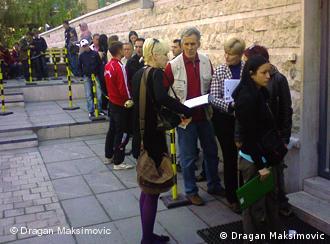
The EU Commission has proposed lifting the visa requirements for people from Serbia, Montenegro and Macedonia from next year. But Bosnian Muslims feel excluded - they will have to wait longer for open borders.
Sada Domanagic is a pensioner living in the capital of Bosnia-Herzegovina, Sarajevo. She wants to visit her sister in Slovenia, and she's applying for a visa. She finds it a humiliating business, especially as Slovenia, which is now part of the European Union, used to be part of Yugoslavia, just like Bosnia-Herzegovina.
She's had to get her sister to give a guarantee that she will take financial responsibility for her, she's had to prove that she has a flat in Bosnia, and she's had to send in her pension slips for March, April and May.
"And I'm a pensioner!" she says. "What must it be like for young people! If it weren't for the fact that I want to visit my sister, I wouldn't mess about with all this."
Bosnians suspect anti-Muslim discrimination
Amar Basic is a 24-year-old student of English literature. He's disappointed in the EU. He's a Muslim - a Bosniak - but he wants to put all the nationalist differences of the past behind him.
And he's worried that the decision to grant visa-free travel to Bosnia's neighbors will only cement the ethnic divisions in the country. Ethnic Serbs and Croats in Bosnia can apply for Serbian and Croatian passports, but the Muslims have no way out.
Basic has written an open letter to the EU in which he points out that Ratko Mladic, the former Bosnian Serb general who is wanted for war crimes, is entitled to a better passport than his victims.
"This creates this conception that the EU is anti-Bosniak or anti-Muslim or anti-victim," he says.
He has some support within the EU. For example, Daniel Cohn-Bendit, head of the Green group in the European Parliament describes it as "morally unacceptable."
He admits that there's a technical problem, in that, according to the Commission, the Bosnians have been unable to introduce the biometric passports which the EU requires.
"But it's still not on," he says, "that Bosnian Serbs will be able to benefit, and the only ones who can't travel are the Bosnian Muslims."
"Lack of political insight"
Christian Schwarz-Schilling, who served as the international community's high representative for Bosnia from May of 2006 to June of 2007, doesn't even believe that technical reasons are behind the discrimination. "I know that the progress in providing biometric passports is on the same level in Bosnia-Herzegovina as in Serbia," he told Deutsche Welle.
He argues that the problem is that the politicians of the mainly Serb entity within Bosnia, the Republika Srpska, refuse to hand over the control of their borders to the central government.
"This is not a technical matter," he says. "It's a highly political matter. There were wars and genocide 15 years ago [over these issues]. It just shows that in Brussels they have no political insight, and they don't care about the political situation of the people. It's the people that matter, and not the games of some political figures."
Schwarz-Schilling would like to see the EU put more pressure on Bosnia to sort itself out. He says until all the countries of the western Balkans can enjoy visa-free travel, the program should be delayed.
The same applies to Kosovo, where ethnic Serbs will be able to use Serbian passports while ethnic Albanians will have to wait in line at the embassies.
Meanwhile Sada Domanagic has had her appointment with the Slovenian embassy. She's got her visa, but it isn't valid until two days after she'd planned to travel.
"They wouldn't give me back my passport immediately," she complains. "They take their time, apparently, until they look through all the papers. I'm very annoyed."
Frank Hoffmann / Michael Lawton
Editor: Chuck Penfold
(Deutsche Welle)
Muslims in Germany: Life in a Parallel Society
 By Norbert F. Pötzl
In Germany, Islam is often equated with fundamentalism and fanaticism, a perception that imposes a heavy burden on the country's 3 million Muslims. Their relationship to Western society is divided between integration and sometimes self-imposed exclusion.
The name of the salon is German -- Goldene Finger (Golden Fingers) -- but the services it offers are listed in the window in Arabic and Turkish. In the front of the shop, 40-year-old Palestinian Toufic al-Rifae gives men haircuts and trims their beards. Veiled women disappear into a back section behind a curtain, where female hairdressers do their hair and, using thick lines of the traditional Middle Eastern cosmetic preparation known as kohl, apply their makeup in the Arab style.
Diagonally across the street, Ris A, a restaurant specializing in grilled meats, advertises its poultry as "halal," or slaughtered according to Islamic religious rules. The place is reminiscent of a McDonald's fast-food restaurant, with its colorful plastic tables and chairs and tiled floor. In an open kitchen in the corner, 72 chickens are being roasted over coals on a large rotating grate. The name of the restaurant, explains the owner, a 35-year-old Lebanese man, "means in Islam: 'What Allah has bestowed upon me'."
Al Sundus is a shop specializing in "Arab lingerie," Arab water pipes, known as shishas, are bubbling away in the El Salam café and neighborhood bakeries sell rectangular cakes coated in white cream or decorated with bright green pistachios. One Middle Eastern business after another lines the northern end of Sonnenallee, a prominent street in Berlin's Neukölln neighborhood.
For some, Sonnenallee is a colorful, quirky shopping street. Others refer to it derisively as the Gaza Strip.
...
(Full article on Spiegel Online- Part 1 and Part 2)
Muslim organizations in Germany

Only a minority of the Muslims residing in Germany are members of religious associations. The ones with the highest numerical strength are:
* Diyanet İşleri Türk İslam Birliği (DİTİB): German branch of the Turkish Presidency for Religious Affairs, Cologne
* Islamische Gemeinschaft Milli Görüş: close to the Islamist Saadet Partisi in Turkey, Kerpen near Cologne
* Islamische Gemeinschaft Jamaat un-Nur: German branch of the Risale-i Nur Society (Said Nursi)
* Verband der islamischen Kulturzentren: German branch of the conservative Süleymancı sect in Turkey, Cologne
* Islamische Gemeinschaft in Deutschland organization of Arab Muslims close to the Muslim Brotherhood, Frankfurt
* Verband der Islamischen Gemeinden der Bosniaken: Bosnian Muslims, Kamp-Lintfort near Duisburg
Furthermore there are the following umbrella organisations:
* Zentralrat der Muslime in Deutschland, domimated by the "Islamische Gemeinschaft in Deutschland" and the "Islamisches Zentrum Aachen"
* Islamrat in Deutschland, dominated by Islamische Gemeinschaft Milli Görüş and its suborganisations
In addition there are numerous local associations without affiliation to any of these organisations. Two organisations have been banned in 2002 because their programme was judged as contrary to the constitution: The "Hizb ut-Tahrir" and the so called "Caliphate State" founded by Cemalettin Kaplan and later lead by his son Metin Kaplan.
(Wikipedia)
See also: Deutschland Online
Book: Islam in Europe Diversity, Identity and Influence

Edited by Aziz Al-Azmeh
Central European University, Budapest
Effie Fokas
Hellenic Foundation for European and Foreign Policy (ELIAMEP)
Events over recent years have increased the global interest in Islam. This volume seeks to combat generalisations about the Muslim presence in Europe by illuminating its diversity across Europe and offering a more realistic, highly differentiated picture. It contends with the monist concept of identity that suggests Islam is the shared and main definition of Muslims living in Europe. The contributors also explore the influence of the European Union on the Muslim communities within its borders, and examine how the EU is in turn affected by the Muslim presence in Europe. This book comes at a critical moment in the evolution of the place of Islam within Europe and will appeal to scholars, students and practitioners in the fields of European studies, politics and policies of the European Union, sociology, sociology of religion, and international relations. It also addresses the wider framework of uncertainties and unease about religion in Europe.
Contents
1. Introduction Effie Fokas; 2. Christians and Muslims: memory, amity and enmities Tarek Mitri; 3. The question of Euro-Islam: restriction or opportunity? Jorgen Nielsen; 4. Muslim identities in Europe: the snare of exceptionalism Jocelyne Cesari; 5. From exile to diaspora: the development of transnational Islam in Europe Werner Schiffauer; 6. Bosnian Islam as European Islam: limits and shifts of a concept Xavier Bougarel; 7. The regulation of religious diversity by the institutions of the European Union: the case of Islam Bérengère Massignon; 8. Development, discrimination and reverse discrimination: effects of EU integration and regional change on the Muslims of Southeast Europe Dia Anagnostou; 9. Breaching the infernal cycle: Turkey and the European Union Valérie Amiraux; 10. Afterword Aziz al-Azmeh.
Reviews
"Perhaps no mistake is greater in discussion of the contemporary world than the belief that identity is one-dimensional, and fixed, and that, on its own, religion, as part of such identity, can explain social and political behavior. The essays in this volume challenge such simplistic ideas in general, and the particular variant that is applied to Muslims, in the Middle East and in Europe, and as much by Islamist fundamentalists as by western observers. In disaggregating ‘identity’ and in demonstrating the many varieties of ethnicity, context, religious practice, class belonging and political affiliation of the Muslims who live in Europe, Aziz Al-Azmeh and Effie Fokas have produced a book of great relevance to public debate and academic research alike." - Professor Fred Halliday, London School of Economics, author 100 Myths About the Middle East (2005)
"Scholars of European politics, religion and politics, and the politics of Islam will certainly profit from a close reading of this volume. It deserves to influence serearch, teaching, and broader public discussion of the future of Europe and its increasingly heterogeneous societies." --Andrew C. Gould, University of Notre Dame: Comparative Politics Book Reviews
Contributors
Effie Fokas, Tarek Mitri, Jorgen Nielsen, Jocelyne Cesari, Werner Schiffauer, Xavier Bougarel, Bérengère Massignon, Dia Anagnostou, Valérie Amiraux, Aziz al-Azmeh
(Cambridge University Press)
Subscribe to:
Posts (Atom)